

By Stephanie Clough
Feb 04, 2026
.jpg?width=475&height=475&name=BEFORE%20MCM%20Broyhill%20Brasilia%20Credenza%20-%20midcentury%20furntiture%20restoration%20services%2c%20raleigh%2c%20nc(1).jpg) Mid-Century Modern’s sleek lines and innovative materials made it one of the 20th century’s defining furniture styles!
Mid-Century Modern’s sleek lines and innovative materials made it one of the 20th century’s defining furniture styles!
Nearly 80 years on, it is still a beloved, high-style design choice.
Where did this iconic style come from?
What makes a piece MCM?
How was its construction different from traditional antique furniture?
Does it need special restoration techniques?
At Mumford Restoration in Raleigh, NC, we regularly evaluate and restore Mid-Century Modern furniture, from teak case pieces to molded plywood chairs.
Take a look at our mid-century modern page to see examples of MCM pieces we've brought back to life!
We've assembled this guide to teach you how Mid-Century Modern furniture was built, how to identify common structural and finish problems, and how professional restoration addresses those issues.
Above: After a full restoration, this Broyhill Brasilia cabinet looks as beautiful as ever.
What Is Mid-Century Modern Furniture (and What Years Does It Cover)?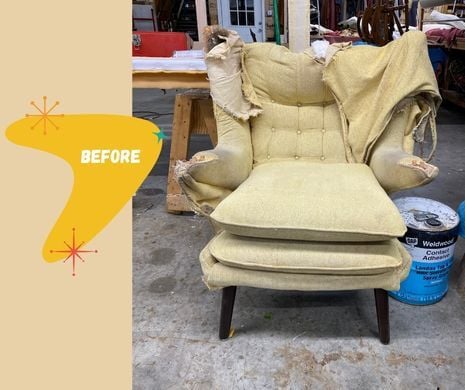
Mid-Century Modern furniture refers to furniture designed primarily between the late 1940s and the early 1970s, characterized by clean lines and functional forms.
It is known for its elegant silhouette and comparatively minimal use of ornamentation.
These features were seen as a departure from more traditional “fussy” furniture design and decor.
Overall, MCM style reflected the post-war mindset of efficiency and futurism.
Ornate carving, dark stains, and a sense of mass were out.
Clean lines, lighter stains, and a feeling of airiness were in.
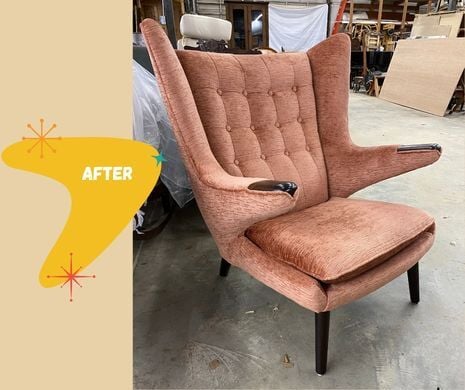
Above & Left: This mid-century modern chair is an excellent example of the playful shapes and angles that furniture, architecture, and art experimented with in the 1950s and 1960s.
Origins of Mid-Century Modern Furniture Design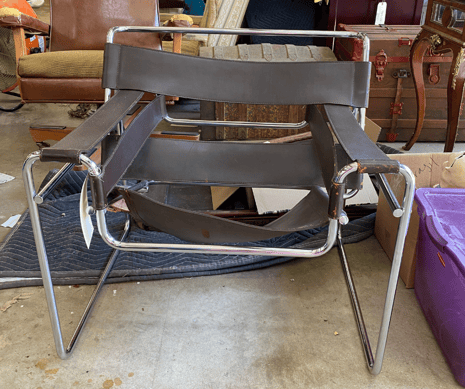
Mid-Century Modern furniture design originated in the Bauhaus Movement of 1920s Germany.
This movement was born in 1919 with the establishment of the Bauhaus State School in Weimar, Germany.
The Bauhaus School’s faculty members were among the most daring architects and artists of the era.
They encouraged students to experiment with materials such as wood, glass, fiber, paper, and metal and employ geometric designs.
The goal was to create art, architecture, and furniture that combined modern and traditional materials and most importantly: functioned.
Students were also expected to challenge engineering and apply physics in new ways.
.jpg?width=465&height=390&name=Barcelona%20Chair%20Frame%3B%20mcm%20furniture%3B%20mid-century%20furniture%20repair%20%3B%20bauhaus%3B%20raleigh%2c%20nc(1).jpg) The curriculum included balancing exercises in which students had to design items with unexpected and challenging angles and mass and ensure that these items remained stable. Items had to explore form and function.
The curriculum included balancing exercises in which students had to design items with unexpected and challenging angles and mass and ensure that these items remained stable. Items had to explore form and function.
Bauhaus faculty member Joseph Albers stated, “We do not always create ‘works of art,’ but rather experiments; it is not our ambition to fill museums.”
These principles translated into sculpture, paintings, architecture, and furniture design. Bauhaus faculty members created several furniture pieces whose legacy flourished decades after their creation.
In 1929 Ludwig Mies van der Rohe created the Barcelona Chair, which he envisioned as an easily mass-produced chair frame of metal and leather that would hold separate seat and back cushions.
In 1925 Marcel Breuer, head of cabinetmaking, created the Wassily chair (named for Wassily Kandinsky, another Bauhaus faculty member). The chair was made of tubular metal and, like the Barcelona chair, was intended to be easily mass produced.
These designs and principles heavily influenced Art Deco furniture, then International Style furniture, and finally Mid-Century Modern furniture.
Above, Right: The Wassily Chair often needs its leather replaced as it dries out and wears over time.
Above, Left: The Barcelona Chair also needs occasional leather replacement, but the chair's design also places stress on the screws holding the joints together. If these screws break, they can be difficult to remove.
How Can You Identify Mid-Century Modern Furniture?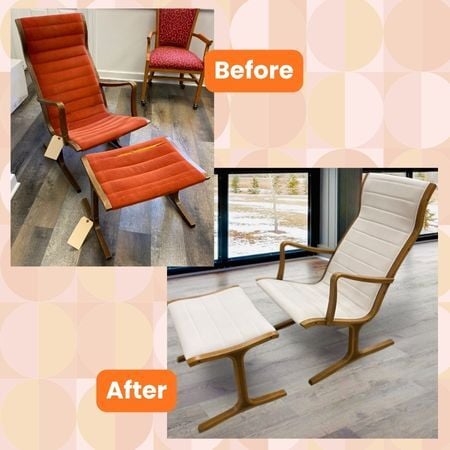
Mid-Century Modern furniture can be identified by its simplified forms, functional design, and distinctive material choices.
Its hallmarks include:
-
Pared-down or no ornamentation
-
Clean lines and simple geometric shapes
-
Slim tapered legs
-
Often light or lighter wood such as teak, birch, and ash
-
Natural-colored wood juxtaposed with contrasting man-made materials such as chrome or glass
-
Modest, practical scale that fit easily into smaller homes and apartments
-
Often bright and playful colors
Above: This MCM chair looks beautiful in its original orange as well as its fresh white upholstery!
Materials Used in Mid-Century Modern Furniture
Mid-Century Modern furniture combined traditional woods (teak, birch, maple, ash, fruitwood, etc.) with easily-
produced industrial elements.
Continuing the Bauhaus tradition of experimentation, MCM furniture played with modern materials such as fiberglass and molded plastic, particularly in the case of chairs.
These mass-produced materials included:
-
Glass
-
Metal (such as aluminum and steel)
-
Molded plastic
-
Fiberglass
-
Vinyl
Watch the video above to learn about Mumford Restoration's work on an egg chair (aka egg pod chair or easter egg chair), a popular piece of MCM furniture that featured a fiberglass "shell."
How Was Mid-Century Modern Furniture Constructed?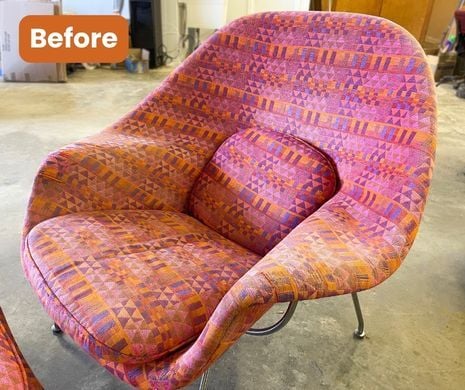
Mid-Century Modern furniture construction emphasized efficient, simplified forms and mass–produced components.
There were no intricate carvings or heavy woods; its elements tended to be basic geometric shapes, and substrates were generally plywood or other composite woods.
Fabrics also came in a variety of natural and synthetic fabrics: leather, wool, tweed, linen, mohair, vinyl.
Unlike its predecessor, International Style, MCM furniture celebrated color.
Its upholstery could, of course, come in gray, white, and black, but it was also common to see teal, red, orange, and a variety of eye-catching shades.
 What Types of Joinery Are Common in Mid-Century Modern Furniture?
Mid-Century Modern furniture employed mortise-and-tenon joints, dowels, machine screws, and various other joinery constructions. As such, there is no single type of joinery that defines MCM furniture.
Bernard Mumford, the founder and co-owner of Mumford Restoration, has worked on countless MCM pieces over his 40+ year career in furniture restoration.
Mumford observes, “MCM designers were experimenting with all of the joinery that was possible in order to make their engineering and physics responsible and durable.”
Mumford enthusiastically adds, “That’s part of the joy of restoring it: discovering what type of joinery they used to make the physics work! An example is an Eames chair that uses rubber and machine screws in order to bring some flexibility. Who would have thought to use rubber?!”
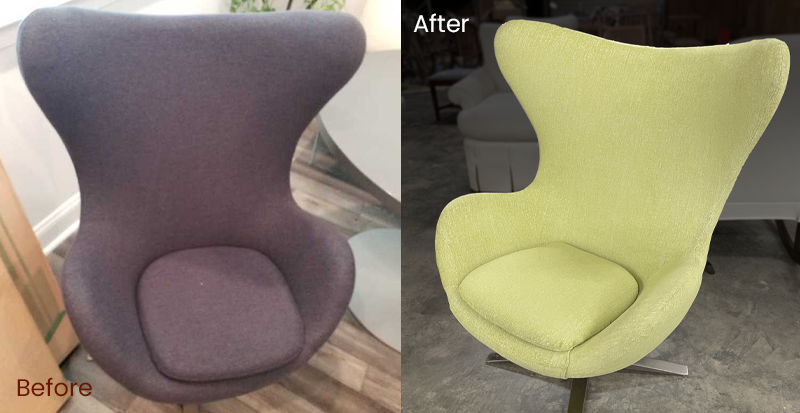
Above right and above left: This MCM womb chair's owners wanted to keep its upholstery bright, so we exchanged pink for orange!
Why Does Mid-Century Modern Furniture Use Veneer?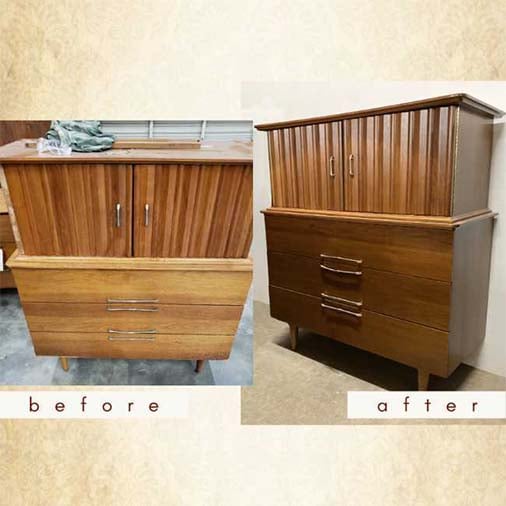
Veneer was widely used in Mid-Century Modern furniture to make high-quality woods more affordable and suitable for mass production.
By using a thin sheet of a pricey (or rare) wood, furniture buyers were able to enjoy wood types and styles that were otherwise cost-prohibitive.
Post-war consumers could now afford to have beautiful and elegant pieces in their homes.
Mid-Century furniture certainly did make use of solid woods, particularly in the case of designer pieces, but these were rarer. Many MCM pieces were veneered.
Bernard Mumford explains, “Part of [veneer usage] was due to the cost of manufacturing using veneers. Usually a designer was figuring out physics and using solid woods when he designed and built a piece, but when it turned to mass production and manufacturing they would use composite woods to keep the cost low.”
Does veneer mean my piece of furniture is cheap or bad?
No, veneer does not make a piece of furniture cheap.
In fact, veneer is a common feature of many styles of furniture from many eras. It was a way to optimize use of desirable species of wood.
You’ll see veneers such as flame mahogany and burled walnut on extremely rare and valuable antiques.
What Finishes Were Common on Mid-Century Modern Furniture?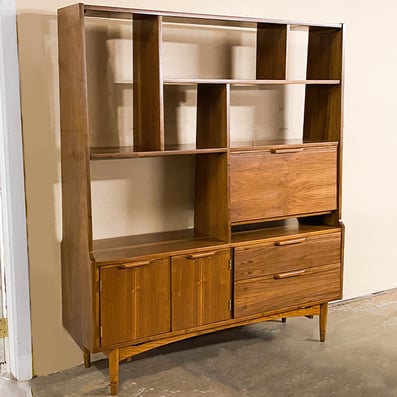
Lacquer and teak oil were the two most common finishes used on Mid-Century Modern furniture.
Lacquer finishes were popular for pieces that would be regularly used, as this finish is strong, clear, and easily maintained.
Read our blog on modern lacquer to learn more about this strong, versatile finish.
High-end, designer pieces intended for occasional use would often be finished with teak oil.
Above: Mid-century furniture encouraged a feeling of space and openness, as you can see in this cabinet that our experts restored.
What Are the Most Common Problems in Mid-Century Modern Furniture?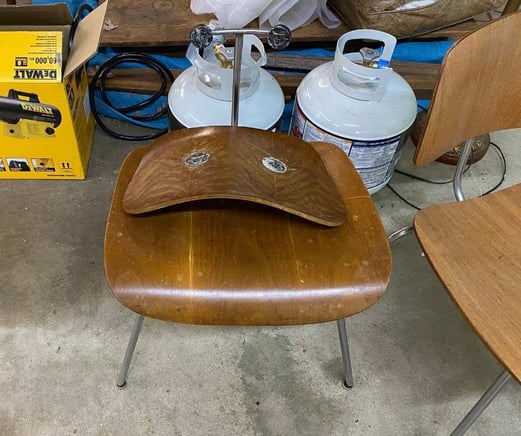
Common problems in Mid-Century Modern furniture include joint failure, finish wear, and degradation of experimental materials.
Rubber elements can detach, metal fasteners can work themselves loose and become lost, and most commonly, joinery can fail due to the unusual angles that sometimes create stress points.
Midcentury furniture experimented with materials, physics, and design. This created iconic and fascinating pieces, but as with any experiment, it can pose problems.
For Mumford, finishes are the most common repair. He notes, “In many cases, the original finish was just teak oil, which was not made for everyday use. It creates the mid-century look, but maintenance is labor-intensive and the finish itself is not very durable.”
Above: An MCM molded plywood chair's rubber components detatched from the back of the chair. This is a common repair for this style of chair.
Can Mid-Century Modern Furniture Be Refinished Without Lowering Its Value?
Refinishing can either lower or raise the value of Mid-Century Modern furniture depending on the piece.
We recommend you speak with an appraiser regarding the value before you refinish MCM furniture that you believe could be valuable.
The appraiser will be able to advise whether restoration is the right choice for your piece.
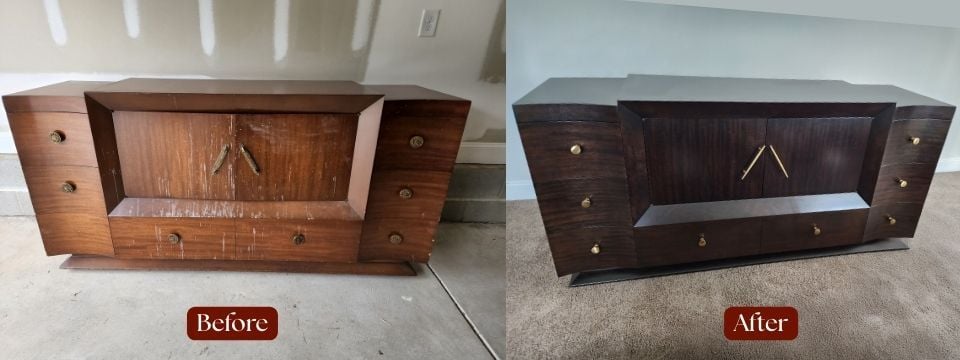
Above: Mid-century modern furniture tended to have light to medium stains, but you can choose to refinish it with a darker stain and updated hardware.
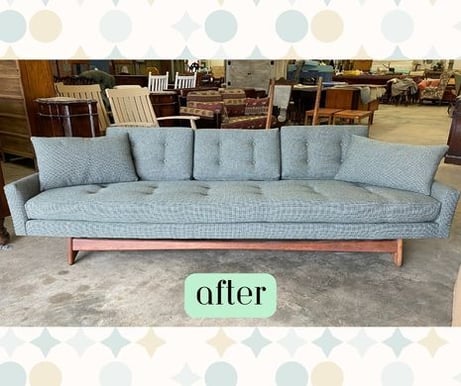
Should You Restore, Refinish, or Conserve Mid-Century Modern Furniture?.jpg?width=465&height=390&name=blog%20BEFORE-%20MCM%20Midcentury%20Sofa-%20greenbrown%20to%20blue%20gray-%20upholstery%20services%2c%20raleigh%2c%20nc(1).jpg)
The appropriate treatment depends on the piece’s historical importance, condition, and intended use.
Consult with an appraiser if you have questions on the value of the piece.
Conservation is about stabilization and primarily consists of gentle cleaning and minimal to no touchups. It is for pieces whose value or significance would decrease if they were restored.
Restoration takes a piece back to a specific moment in its history: that could be when it was first built in 1952, when your grandmother made changes to it in 1970, etc.
Refinishing can mean preserving a piece’s appearance but using modern finishes, painting it a different color, or returning it to its original materials and hardware.
 How Do Professionals Repair Veneer Damage on Mid-Century Modern Furniture?
Professional veneer repair involves replacing damaged veneer with matching wood and blending the repair into the surrounding surface.
Mumford Restoration’s experts select a replacement veneer of the same species and grain pattern as the surrounding veneer.
We remove a small area around the damaged veneer, insert replacement veneer of the same size, and attach it using carpenter’s glue.
After the glue sets, we sand the area, apply stain, faux grain if necessary, and finish with sealer and lacquer.
How Do Professionals Fix Loose Joints and Structural Issues in MCM Furniture?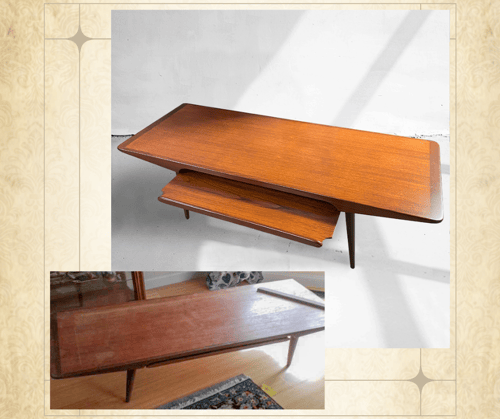
Loose joints are repaired by evaluating the structure, reinforcing weakened areas, and reassembling the piece correctly.
We inspect the loose joint you’ve noticed, test the piece to see if additional areas have begun to fail, and show you the areas of weakness.
Due to the experimental engineering of mid-century modern furniture, solutions can sometimes be more complicated than they are for traditional furniture.
To learn more about our repair process, read our related blog article about 5 types of repairs we commonly make to antique and vintage furniture.
How Do You Clean Mid-Century Modern Furniture Without Damaging the Finish?
Cleaning methods depend on whether the furniture has a lacquer or teak oil finish.
Read our blog for general tips for furniture cleaning.
For lacquer finishes in good condition, wipe occasionally with a lightly damp cloth and immediately dry with a soft, clean cloth.
For teak oil finishes, apply teak oil in several coats according to the manufacturer’s instructions.
-
Do not use harsh chemical cleaners.
-
Do not use big-box-store furniture polish such as Pledge or Old English, as silicone penetrates the finish and may undermine future refinishing efforts.
How Do You Tell an Authentic MCM Piece from a Reproduction?
Authenticating Mid-Century Modern furniture requires knowledge of manufacturers, construction methods, and historical documentation.
Every manufacturer had its own hallmarks, so authenticating a piece depends on thorough knowledge of the maker, its maker's marks through the years, and the period of manufacture.
Research the type of piece you are interested in using historic advertisements, catalogs, and design references.
If you own the piece, contact a reputable appraiser for professional authentication.
Is Mid-Century Modern Furniture Worth Restoring?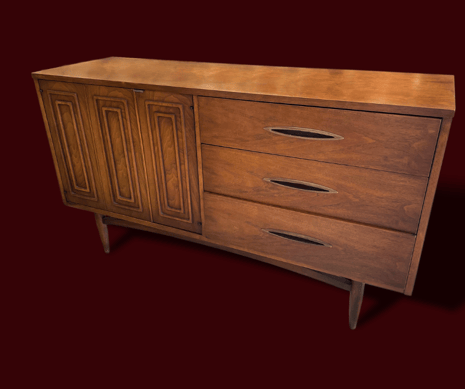
Mid-Century Modern furniture is often worth restoring due to its craftsmanship, design significance, and continued popularity.
The real question is whether you want to invest in restoration.
Restoration might be the right choice for you, if you answer yes to any of the following:
-
Is the piece sentimental?
-
Is it a piece you love and want to preserve?
-
Is it collectible and appraised for resale?
Where Can You Get Mid-Century Modern Furniture Restored in Raleigh, NC?
Professional restoration ensures Mid-Century Modern furniture is repaired using appropriate materials and techniques.
Mumford Restoration is among the most trusted antique and vintage furniture restoration experts in North Carolina.
We’ve repaired, restored, and reupholstered countless MCM couches, cabinets, chairs, and tables.
Our restoration experts will be happy to talk you through your options and help find the right upholstery, stain, and finish for your mid-century furniture.
We serve Raleigh, the entire state of North Carolina, and beyond, with pickup, delivery, and shipping options available.
Call us today at 919-510-6310 to learn more! Or submit photos via our online form!