

By Stephanie Clough
Feb 17, 2026
Sunlight can severely damage antique furniture and valuable collectibles.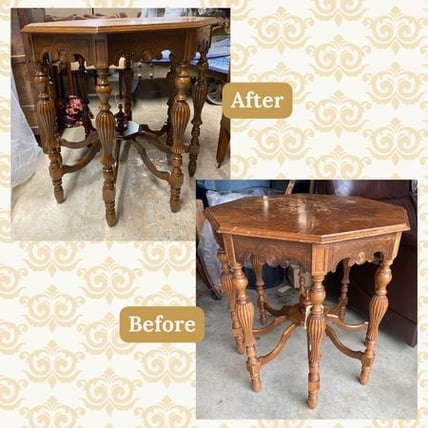
Ultraviolet (UV) rays break down wood fibers, fade original finishes, dry veneers, and weaken historic glues.
Over time, even indirect light from a nearby window can change color, reduce value, and create structural problems.
Understanding how sun exposure affects antiques helps owners prevent deterioration and decide when professional restoration may be necessary.
Damage from light is one of the most common problems furniture restorers encounter.
What Does Sunlight Do to Wood Furniture?
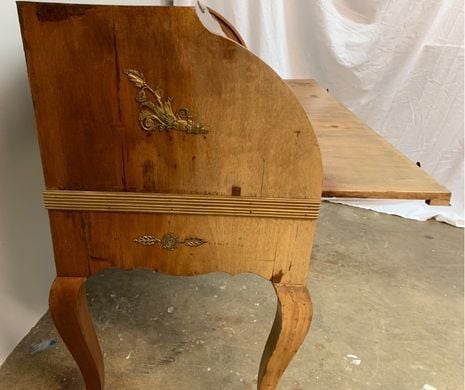
Prolonged sunlight exposure can bleach wood, alter its natural color, and weaken surface fibers, leading to uneven aging and visible fading.
This process is cumulative and accelerates with continued exposure.
If you’ve ever taken a picture off of a wallpapered wall, you have seen the patch of wallpaper that’s as bright and perfect as the day it was hung. Meanwhile, the surrounding wallpaper is dull, faded, and fragile.
That faded color and weakened structure result from UV damage.
 This is called “photo-oxidation.” This process breaks down the bond between molecules until the material loses its structural integrity.
In the case of wooden antique furniture, photons break down the molecular bonds in the wood’s lignin and cellulose. The wood loses its strength as well as its color, as UV light slowly breaks it down.
Bernard Mumford, founder and owner of Mumford Restoration, explains: "The sun cooks the finish, then opens pores, then bleaches wood. It goes right through finish, into the stain and into the wood. At a certain point, it becomes driftwood."
UV light eventually bleaches wood until it is a faint version of its original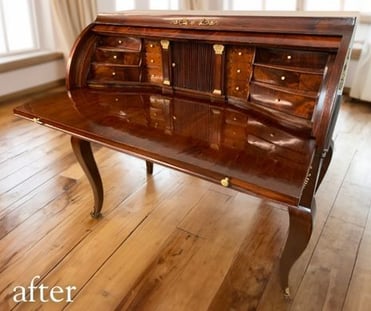
color. This change becomes especially noticeable when only part of the furniture is exposed to sunlight. If the sun regularly falls on half of an antique buffet, one side will be dramatically lighter than the side that was relatively shielded.
This uneven fading will only worsen as your antiques sit exposed to sunlight.
The wood will also become more brittle over time, due to this molecular degradation.
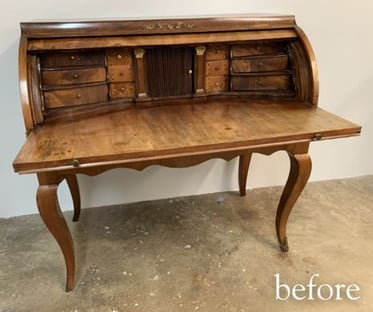
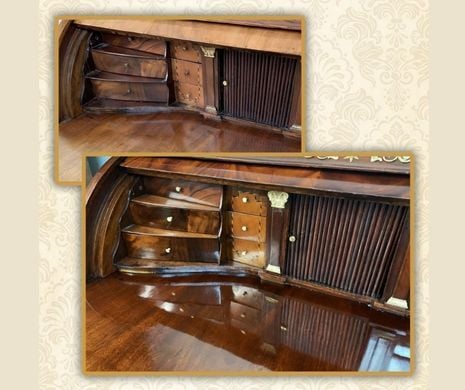
Above: You can see where this antique barrel-top desk was most exposed to UV light! We were able to revive it with a beautiful French polished finish!
How UV Rays Damage Antique Finishes
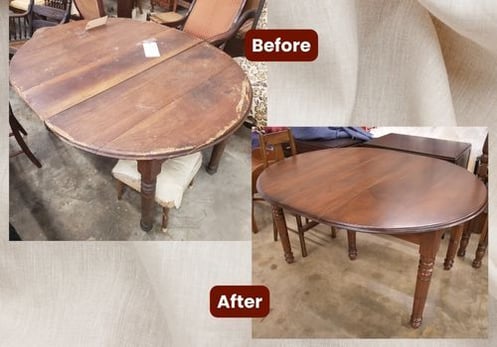 It’s not just wood that suffers from UV damage. Your antique’s finish will also degrade under prolonged exposure to sunlight.
Ultraviolet light breaks down modern lacquer finishes as well as historic finishes such as shellac, lacquer, and varnish, causing dullness, brittleness, and eventual failure of the protective coating.
This finish degradation can begin with a loss of sheen and can continue until you notice brittleness and cracking in what was once a beautiful finish.
Once your protective coating has degraded, your furniture is no longer safe from spills and other damage.
Why Veneer Lifts and Glue Fails in the Sun
Heat and UV exposure cause wood and its substrate to expand and contract at different rates, which can loosen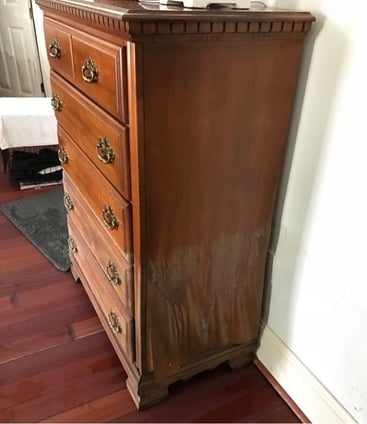 adhesives and lead to veneer lifting or delamination.
When adhesive fails and veneer lifts off of the substrate, we call this “delamination.”
The heat itself is also a culprit in delamination.
Furniture relied on hide glue until the 20th century. And conservators still rely on hide glue for its easy reversibility. What is a way of easily reversing hide glue? Applying heat.
Sun exposure heats hide glue until it reactivates and becomes sticky again. This soft reactivated glue allows the veneer to lift and move. When it dries again, the veneer may be warped, bubbled, askew, or completely loose.
Even furniture that uses modern, PVA glue (also known as carpenter’s glue) can delaminate due to prolonged sun exposure. The physical stress of the wood’s expansion and contraction can be stronger than the glue can withstand. Eventually, the stress is sufficient to pull the veneer away from the substrate.
Above: This chest of drawers delaminated due to water-damage, another cause of veneer damage.
What Fading and Discoloration Mean for Value
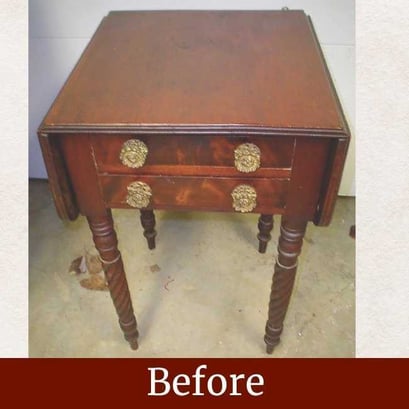
Uneven fading or discoloration can affect an antique’s originality and may reduce collector interest depending on the rarity and historical significance of the piece.
For significant antiques, preserving original materials is often critical to maintaining market value.
Antique value often hinges on historic integrity, meaning the preservation of original elements such as finish, hardware, inlays, and wood.
Sun damage reduces this value, by weakening and fading the wood. Inappropriate restoration or conservation work could compound the damage and reduce collector interest.
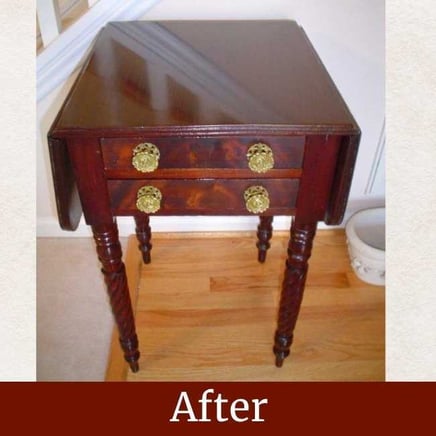 Examples of things you might avoid:
-
Completely replacing historic veneer (not just carefully regluing and then patching where absolutely necessary)
-
Stripping off a French polished finish (or other historic finishes)
-
Regluing elements by using incorrect materials or methods
-
Using the historically incorrect material to color correct faded patches
As always, consult an appraiser before you begin work on a valuable antique.
Can Sun-Damaged Furniture Be Restored?
 Early intervention typically produces better cosmetic and structural results than delayed treatment.
Bernard Mumford counsels furniture owners not to panic if they notice sun bleaching and adds, "The bleached wood appearance is restorable because it is only 1/32” deep."
Many forms of sun damage can be improved through professional restoration, but the success of treatment depends on how deeply light has affected the finish or wood.
In many cases, a professional restorer can use toner to color correct small faded patches on less noticeable areas. For example, if a few inches of the bottom of a table leg faded, a touchup might easily blend.
However, color correction cannot reverse structural weakening caused by UV degradation.
When Fading Requires Refinishing Instead of Touch-Up
A professional restorer can determine whether damage has penetrated too large an area for localized repair.
When discoloration affects a large or noticeable area, touch-ups may not blend in with the original finish and color.
In these cases, professional refinishing may be the best repair option.
How to Protect Antique Furniture from Sunlight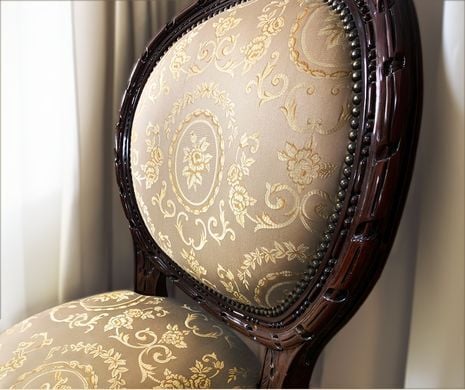
Preventing UV damage involves limiting direct exposure through window coverings, UV-filtering film, and thoughtful furniture placement.
A good, light-filtering curtain can dramatically reduce your antique wooden furniture’s risk of sun damage.
If a curtain is not an option, you can also buy UV-filtering window films. There are many window film options, some of which are static cling films that do not require any adhesive.
A third option is moving the furniture to a safer, less-exposed location in the room. This should be away from any sunlight (and heating and cooling vents) to avoid fading and temperature variations.
Bernard Mumford notes that he stresses UV protection for all furniture that may be exposed to sunlight, but especially for very valuable pieces. He explains that he does not begin work until grand piano owners commit to installing UV protection, "I won’t deliver a grand piano to a set of windows that do not have the a 3M Mylar window film fitted. It only lets 3% of UV light in."
Mumford has noticed that homeowners have a false sense of security due to their energy-efficient windows. He notes, "These energy-efficient windows provide insulation to keep heat and cold from coming in, but they don't provide much UV protection. It’s better to add UV protection in the form of a film. At the very least shut the blinds! "
Preventive measures are far less costly than corrective restoration.
Our article "4 Ways to Protect Antique Furniture" will give you an overview of some of the best and easiest to protect your furniture.
When to Call a Professional Furniture Restorer
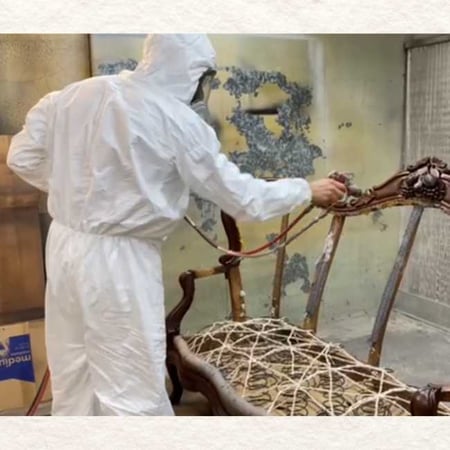
A trained restoration specialist can evaluate sun damage, determine whether conservation or refinishing is appropriate, and recommend a treatment that protects long-term value.
Sunlight damage to antique furniture often happens gradually, but the effects can become severe and difficult to correct if ignored.
Early evaluation by an experienced restoration professional can determine whether fading, finish failure, or veneer movement can be stabilized or reversed.
At Mumford Restoration, our specialists evaluate sun damage every day and help owners choose treatments that protect both appearance and value.
Noticing fading, cracking, or veneer movement?
If you’re concerned about sun damage to your antique furniture, Mumford Restoration’s experts can help you understand what is urgent and what can wait.
Request a consultation and send photos via our online form or speak to one of our restoration specialists today at 919.510.6310.