

By Stephanie Clough
Jul 07, 2026
Why is there a crack along the entire surface of your table?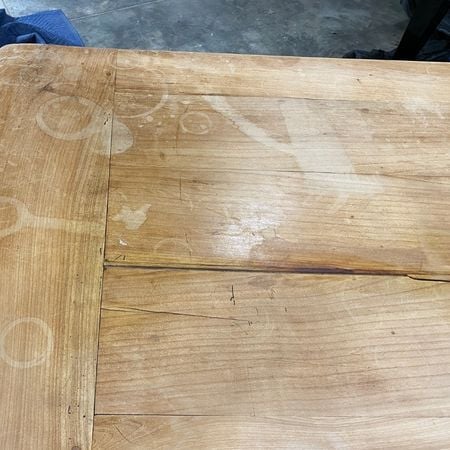
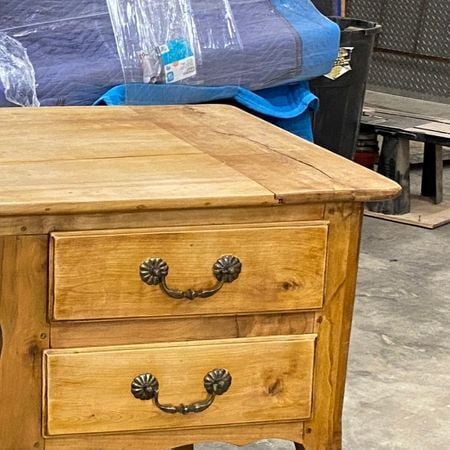
What caused a split along the side of your dresser?
Did the movers drop it? Did something fall on it?
More importantly, does a crack mean your furniture is ruined?
Don't give up on cracked antique furniture!
A professional furniture restorer can very likely stabilize and repair the damage.
Cracks are common in wooden pieces. They aren’t necessarily a result of a fall or other physical damage.
In many cases, cracks are a normal result of how wood responds to changes in its environment.
Some cracks are primarily cosmetic, while others may indicate structural problems that require repair.
Understanding why antique furniture splits or cracks can help you determine whether the issue is minor or whether it should be evaluated by a professional furniture restorer.
Above: A deep cracks runs along the writing surface of an antique desk.
Why Does Antique Furniture Crack?
Wood is a natural material that constantly responds to changes in temperature and humidity.
Even after a tree is cut down and transformed into furniture, the wood continues to absorb and release moisture from the surrounding air.
As humidity increases, wood expands.
As humidity decreases, wood contracts.
Over years and decades, repeated expansion and contraction place stress on the wood and can eventually result in cracks or splits.
Common causes of cracking include:
-
low humidity
-
rapid environmental changes
-
previous, improper repairs
-
structural stress
-
accidental impact or physical damage
Above: A desk contained 2 large cracks, both of which ran through the wood. As the wood itself had changed shape due to environmental changes, these cracks could not simply be forced back together.
Are Cracks in Antique Furniture Normal?
Yes, cracks are very common in antique wooden furniture.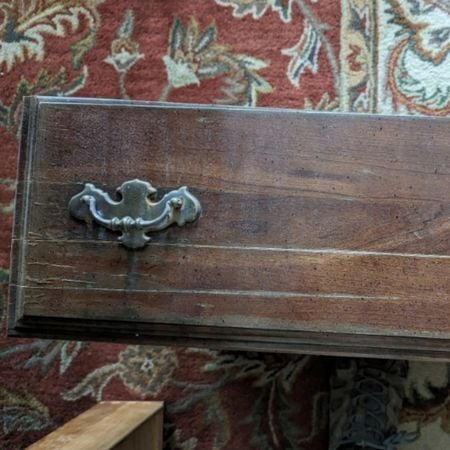
Many antique pieces develop minor cracks during their lifetime.
Furniture that is more than a century old has experienced thousands of cycles of seasonal expansion and contraction.
Small cracks and splits often develop because different parts of the furniture move at different rates.
A minor crack does not necessarily indicate that the furniture is weak or failing.
The location, size, and type of crack are far more important than the mere presence of a crack.
Photo: Cracks can appear in drawers due to temperature and humidity changes.
Does Low Humidity Cause Antique Furniture to Crack?
Yes, low humidity is a common cause of cracks and splits in wood.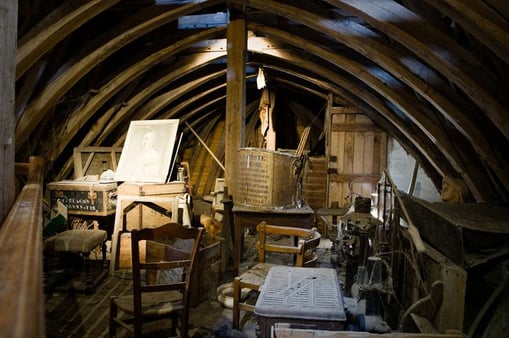
When the air becomes excessively dry, wood loses moisture and shrinks.
If different parts of a piece shrink at different rates, stress develops within the wood.
Eventually, the stress may exceed the wood's ability to flex, resulting in a crack.
This is why furniture often develops cracks during:
-
winter heating seasons
-
significant, prolonged droughts
-
moves between different climates
-
storage in uncontrolled environments
Photo: You'll often notice cracks in furniture that has been stored in attics and storage sheds.
Can High Humidity Cause Furniture Cracks Too?
Indirectly, yes..jpg?width=414&height=347&name=Antique%20Silver%20Chest%20Damaged%20by%20Water_%20Full%20Restoration%20-%20fire%20and%20water%20damage%20restoration%20services-%20Raleigh%2c%20NC(1).jpg)
High humidity generally causes wood to expand rather than crack.
However, repeated cycles of expansion and contraction can gradually weaken the wood and increase stress within the furniture.
Years of environmental fluctuation may eventually contribute to cracking, warping, joint failure, or veneer problems.
Stable conditions are generally healthier for furniture than dramatic swings in humidity.
Photo: Floods and high humidity in general can swell wood. As the wood dries and contracts, cracks and splits can appear.
Are All Furniture Cracks Serious?
No, not all cracks or splits are serious.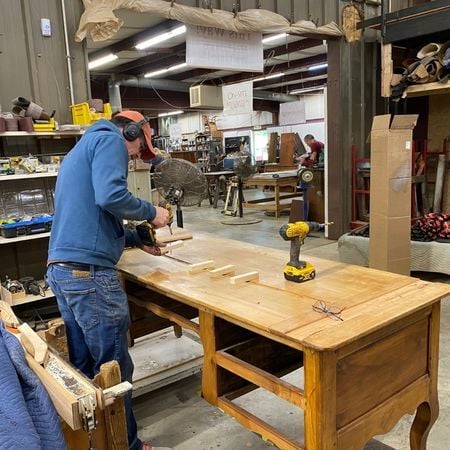
Some cracks are primarily cosmetic, while others affect the structure of the furniture and should be repaired promptly.
Factors that help determine severity include:
-
the location of the crack
-
whether the crack is growing
-
whether the crack affects a joint
-
whether the furniture moves or flexes around the damaged area
A small surface crack may require little or no intervention.
A crack that extends through a structural component may require professional repair.
Photo: Significant cracks and splits require expert repair if you want to stabilize your furniture. Before this desk's cracks and splits could be repaired, our carpenter had to address the wood's downward bowing.
What Is the Difference Between a Finish Crack and a Wood Crack?
This distinction is extremely important.
Sometimes the finish cracks, even though the wood beneath is undamaged.
These finish cracks are often called crazing and may appear as:
-
fine lines
-
spiderweb patterns
While they can affect appearance, they do not necessarily indicate structural damage.
Wood cracks occur inside the wood itself.
These cracks may widen over time and can affect the strength and stability of the furniture.
A professional evaluation can help determine whether the crack is limited to the finish or extends into the wood.
Will a Crack Continue to Grow?
It depends on what caused it.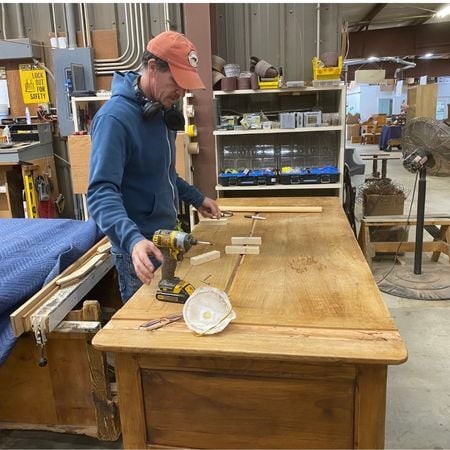
If the environmental conditions that created the crack continue, further movement may occur.
If the crack resulted from a one-time event and the furniture is now kept in stable conditions, the crack could remain relatively unchanged.
It's important to monitor the crack over time.
If you notice the crack widening, changing shape, or affecting nearby joints, professional evaluation is recommended.
Photo: Our master carpenter constructs a system to create a level surface.
Should I Fill Cracks with Wood Filler?
You should not fill a crack or split with wood filler without understanding the cause of the crack.
Wood filler can improve appearance in certain situations, but it does not address underlying structural issues.
If the crack continues moving seasonally, the filler may eventually fail.
Inappropriate fillers can also make future repairs more difficult and may detract from the furniture's historical character.
Before attempting any repair, it is important to determine why the crack developed in the first place.
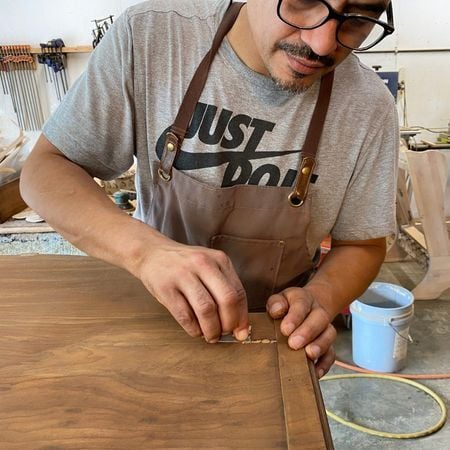
Photo: One of our restoration experts fills a shallow crack with wood filler. Filler is not appropriate for deep cracks that result from serious structural issues within the wood.
Can Cracks in Furniture Be Glued Closed?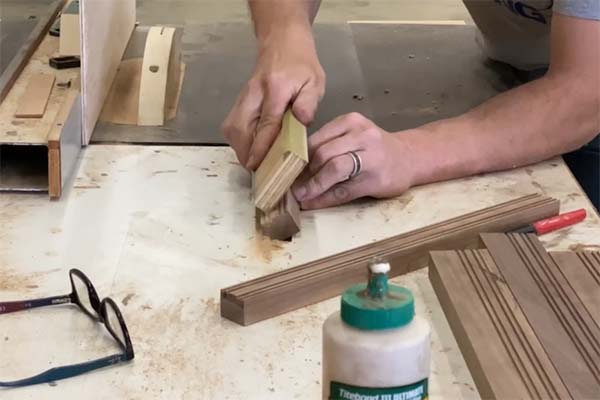
No, simply forcing glue into a crack rarely addresses the underlying cause of the problem.
Before a crack can be repaired, it must first be:
-
cleaned
-
realigned & stabilized
-
clamped
Because cracks appear when wood has experienced permanent structural changes, the wood may not even fit together properly anymore without something called a “spline,” which we will discuss below.
Photo: Glue supports a repair, but it needs a strong, stable wood surface in order to work.
Can Cracked Antique Furniture Be Repaired?
Yes, cracked solid wood furniture can usually be repaired.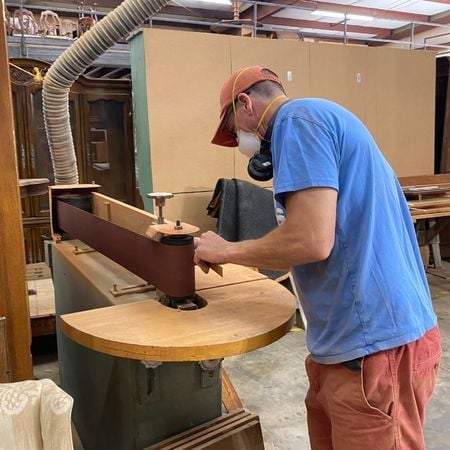
Professional furniture restorers can often:
-
stabilize & close cracks
-
reinforce weakened areas
-
repair damaged joinery
-
preserve surrounding original material
The proper repair method depends on the furniture's construction, condition, age, and historical significance.
Often, a furniture restorer will insert a spline, which is a thin piece of wood that fits into the crack and bridges the now permanent distance between the original wood.
The restorer sands a piece of wood until it is the perfect thickness to close the crack. Too thin, and the spline will not be able to close the split. Too wide, and the spline will force the crack to become larger.
They then glue the spline into the crack and clamp it. This is much like inserting a patch into torn clothing. It closes the gap and provides much needed stability and strength.
The spline can be stained and faux grained to blend into the surrounding wood.
Yes, the furniture's appearance improves, but the ultimate goal is to ensure the furniture remains stable and functional.
Photo: Our master carpenter refines a length of spline that he will use to stabilize a cracked dresser surface.
How Can I Prevent Antique Furniture from Cracking?
While some wood movement is unavoidable, you can reduce the risk of cracking by: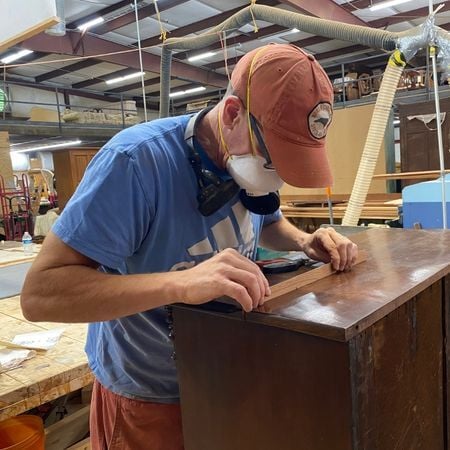
-
maintaining stable indoor humidity
-
keeping furniture away from heat sources
-
addressing minor issues before they become major problems
-
avoiding improper repairs
Antique furniture performs best in a stable environment.
Remember: large swings in temperature and humidity place unnecessary stress on the wood.
Photo: Creating spline that is too thin or too thick will cause additional problems and cause the repair to fail.
When Should You Call a Furniture Restoration Professional?
Professional evaluation is recommended when: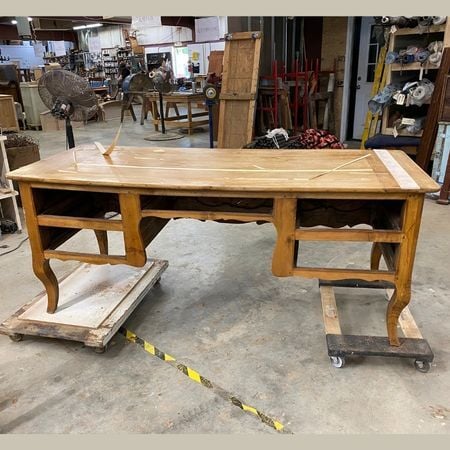
-
a crack appears suddenly
-
the crack is growing
-
the crack affects a joint or structural component
-
the furniture becomes unstable
-
the piece is historically significant or sentimental
Early intervention often prevents minor issues from becoming more extensive repairs.
Photo: This desk is stabilized and ready to be refinished! The replaced sections will blend beautifully with the original wood.
Professional Antique Furniture Repair in Raleigh, NC
At Mumford Restoration in Raleigh, NC, we regularly repair and stabilize antique furniture affected by cracking,splitting, wood movement, and structural stress.
Our approach focuses on preserving original materials whenever possible while ensuring that furniture remains stable, functional, and historically appropriate.
If your antique furniture has developed cracks and you are unsure whether repair is necessary, call us at 919-510-6310 or submit photos through our online form for evaluation.